Elastic deformation is the temporary change in the shape or size of a material when subjected to an external force or stress. Once the applied load is removed, the material returns to its original shape without any permanent damage.
This reversible behavior is fundamental in mechanical engineering, materials science, and tribology, where surface interactions depend strongly on how materials deform under load.
Definition
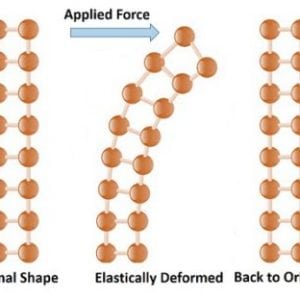
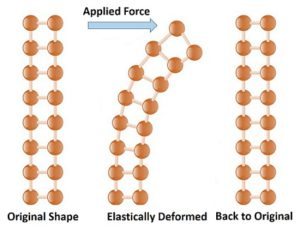
Elastic deformation is a change of the shape of the body as a reaction to applied stress. This deformation is only temporary and once the stress is released, the undeformed shape of the body is restored, as shown in the figure below. In tribology, elastic deformation largely affects elastohydrodynamic film thickness build up, real contact area, etc. A problem of determination of elastic deformation in various scenarios is considered in the classical (linear elasticity) Elasticity Theory book by Timoshenko and Goodier [1].
Elastic deformation explained
In the field of tribology, the most commonly studied configuration of contact is the contact of a sphere or a cylinder with a flat (the contact of two spheres or two cylinders can be reduced to the contact on flat). In this case, a half-space approximation is applicable and the full system of Elasticity Theory equations can be solved analytically to link the elastic deflection of the surface to the applied pressure on the surface [1]. The resultant equation is given in integral form:
(1)
Here is the elastic deflection, is the reduced elastic modulus, are the Poisson’s ratio and Young’s modulus of the bodies, is the contact pressure. This equation is used in most of tribological problems, including EHL problems, but also in contact mechanics, friction and wear simulation. Further information regarding the application of the equation can be found in the reference [2].
Factors Affecting Elastic Deformation
Several factors influence how a material deforms elastically:
Material properties (elastic modulus, Poisson’s ratio)
Applied load magnitude
Geometry of contact
Temperature
Surface roughness
Engineers must consider these factors when designing components subjected to repeated loading.
Calculating elastic deformation online
There are several online tools to calculate elastic deformation for special cases.
In Tribology, elastic deformation plays a critical role in determining how surfaces interact under load.
Key effects include:
Real contact area: Surface roughness causes only small regions to touch, and elastic deformation increases this संपर्क area
Friction behavior: Deformation influences how forces are transmitted between surfaces
Lubrication performance: Elastic deformation affects film thickness in elastohydrodynamic lubrication (EHL) systems
Understanding elastic deformation is essential for predicting wear, friction, and system efficiency.
Applications of Elastic Deformation
Elastic deformation is critical in many engineering systems:
1. Mechanical Components
Springs and bearings rely on elastic behavior
Ensures energy storage and recovery
2. Surface Engineering
Determines how rough surfaces interact under load
Affects coating performance
3. Lubrication Systems
Controls lubricant film formation in EHL
Prevents metal-to-metal contact
4. Micro- and Nano-Systems
Important in MEMS/NEMS devices
Influences contact forces at small scales
Contact Mechanics and Elastic Deformation
In many engineering applications, contact occurs between curved surfaces such as spheres or cylinders against flat surfaces.
Using classical elasticity theory:
A half-space approximation is often applied
Surface deflection is related to applied pressure
Analytical solutions are available for simple geometries
These models are widely used in:
Hertzian contact theory
Friction and wear simulations
Elastohydrodynamic lubrication analysis
Limitations of Elastic Deformation Theory
While elastic theory is powerful, it has limitations:
Assumes small deformations
Ignores plasticity and damage
Less accurate for complex geometries
Does not account for time-dependent effects (viscoelasticity)
Advanced models are required when these conditions are not met.
Conclusion
Elastic deformation is a fundamental concept in engineering that describes how materials temporarily respond to applied forces. It plays a critical role in contact mechanics, lubrication, and system performance.
A strong understanding of elastic deformation enables engineers to design more reliable, efficient, and durable mechanical systems.









 is the elastic deflection,
  is the reduced elastic modulus,
  are the Poisson’s ratio and Young’s modulus of the bodies,
  is the contact pressure. This equation is used in most of tribological problems, including EHL problems, but also in contact mechanics, friction and wear simulation. Further information regarding the application of the equation can be found in the reference [2].

0 Comment